Day 3 of The 9th SAMI 2026: Explores Geopolitics, Supply Chains, and Geopark Tourism for Agrifood Sustainability
Day 3 of The 9th SAMI 2026: Explores Geopolitics, Supply Chains, and Geopark Tourism for Agrifood Sustainability
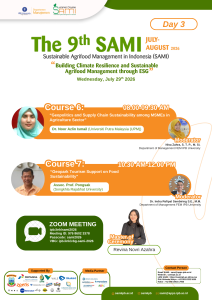
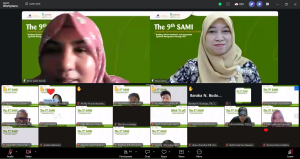
Department of Management, Faculty of Economics and Management IPB University held the third day of the Summer Course The 9th Sustainable Agrifood Management in Indonesia (SAMI) 2026 on Wednesday, July 29, 2026. The third day’s agenda, which was conducted online via Zoom Meeting, focused on exploring geopolitical dynamics, supply chain sustainability among MSMEs, and the integration of geopark tourism to support food sustainability.
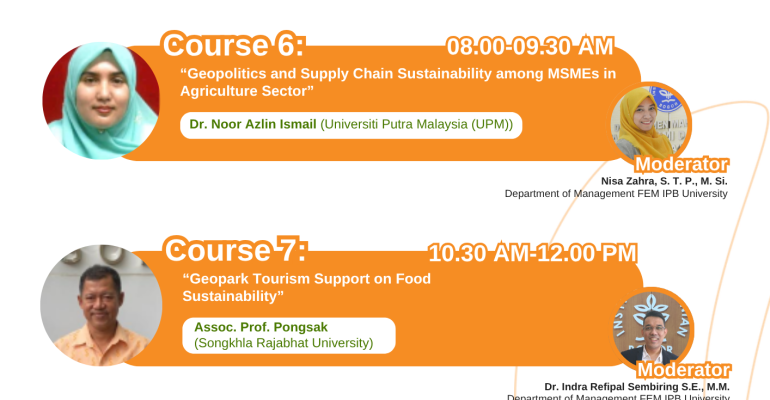
The series began at 08.00–09.30 WIB through Course 6 “Geopolitics and Supply Chain Sustainability among MSMEs in Agriculture Sector”. This session was moderated by Nisa Zahra, S.T.P., M.Si., with Dr. Noor Azlin Ismail from Universiti Putra Malaysia (UPM). The speaker highlighted scarcity as the fundamental economic problem driving international trade and explained classical geopolitical theories such as the Heartland, Rimland, and Sea Power theories. She also outlined major disruptions in global supply chains, including geopolitical tensions around the Strait of Hormuz, the Russia-Ukraine war, and the US-China soybean trade war. Furthermore, Dr. Noor Azlin Ismail highlighted that ASEAN agricultural MSMEs, which employ over 100 million people, face severe fertilizer import dependencies and urged the region to transition toward localized input production and stronger risk-management governance.
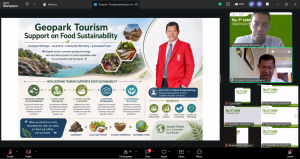
The event continued at 10.30–12.00 WIB with Course 7 themed “Geopark Tourism Support on Food Sustainability”. This session was moderated by Dr. Indra Refipal Sembiring S.E., M.M. as the moderator and presented by Assoc. Prof. Pongsak from Songkhla Rajabhat University, Thailand. In his presentation, Assoc. Prof. Pongsak detailed the four core pillars of geopark management: protecting geological heritage, educating communities, supporting sustainable tourism, and empowering local communities. He presented the “GeoFood” framework, which connects geodiversity, biodiversity, cultural heritage, and traditional food systems to build sustainable local agrifood networks. He emphasized that geoparks create tangible economic benefits for local communities through geology-themed culinary offerings, homestays, and local enterprises, which in turn incentivize local conservation efforts.
The 9th SAMI 2026 program series will continue to present strategic topics and foster collaborative discussions to support sustainable agrifood management.



 Users Today : 459
 Users Yesterday : 258
 Users Last 7 days : 2182
 Users This Month : 5846
 Users This Year : 103608
 Total Users : 168806
 Who's Online : 3