
Day 4 of The 9th SAMI 2026: Explores ESG Integration, Palm Oil Governance, and Sustainable Supply Chains
Day 4 of The 9th SAMI 2026: Explores ESG Integration, Palm Oil Governance, and Sustainable Supply Chains
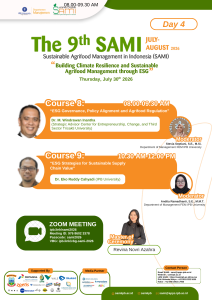
Department of Management, Faculty of Economics and Management IPB University held the fourth day of the Summer Course The 9th Sustainable Agrifood Management in Indonesia (SAMI) 2026 on Thursday, July 30, 2026. The fourth day’s agenda, conducted online via Zoom Meeting, focused on exploring Environmental, Social, and Governance (ESG) frameworks, palm oil governance across food and energy sectors, and sustainable agrifood supply chains.
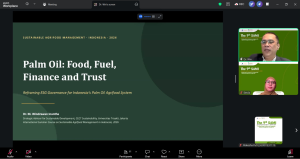
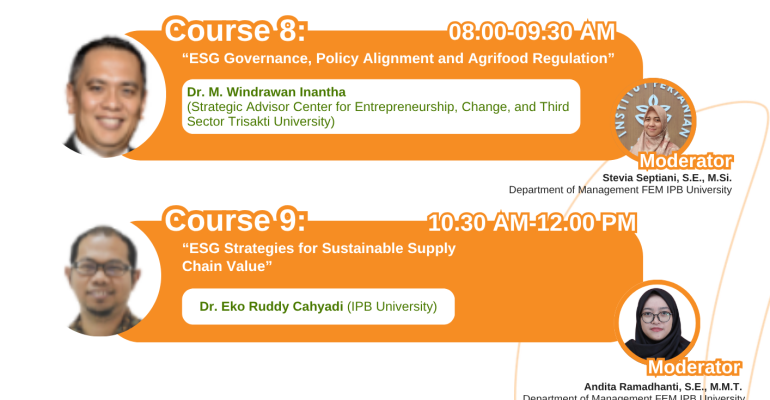
The series began at 08.00–10.00 WIB through Course 8 centered on palm oil governance and ESG integration. This session was moderated by Stevia Septiani, S.E., M.Si., with Dr. M. Windrawan Inantha, Strategic Advisor of CACP Sustainability at Universitas Trisakti and advisor for palm oil companies in Indonesia, as the main speaker. The speaker emphasized that palm oil serves four interconnected systems simultaneously: food, fuel, finance, and public trust. He discussed the transition to the B50 biodiesel mandate introduced in July 2026 and highlighted the necessity of maintaining palm oil’s foundational role as affordable, safe food while balancing energy security. Dr. Win also stressed smallholder inclusion that smallholders contribute roughly 40% of national production, and called for a coherent governance framework across institutions to align national standards like ISPO with global market expectations.

The event continued at 10.30–12.00 WIB with Course 9 themed around ESG frameworks and sustainable agrifood supply chains. This session was moderated by Andita Ramadhanti, S.E., M.Si., and presented by Dr. Eko Cahyadi, an expert in sustainable agri-food supply chain management. Dr. Eko examined “farm-to-table” supply chain dynamics through two major Indonesian export commodities: oil palm and shrimp. He detailed the sector’s paradox of feeding the global population while generating environmental pressures, such as mangrove conversion and peatland degradation. Furthermore, Dr. Eko framed ESG as an essential risk lens, demonstrating how traceability, data integrity, and strong governance lower the cost of capital, manage regulatory risks like EUDR, and secure market licenses to operate.



 Users Today : 440
 Users Yesterday : 258
 Users Last 7 days : 2163
 Users This Month : 5827
 Users This Year : 103589
 Total Users : 168787
 Who's Online : 1